

We have BIG BIG SOLUTIONS SOLUTIONS for small small spaces! Call now! 602-370-1275 Call now! 602-370-1275 E-mail: renovationsbyryan@att.net RENOVATIONS BY RYAN LLC LICENSED, BONDED, INSURED • ROC#206393 www.renovationsbyryan.com Thinking of replacing those pickled oak cabinets? Tired of the avocado shower tile? Have you been putting off throwing a party because your house needs updating? Call us for all of your home remodel projects! We specialize in meeting our customers’ needs! 602-952-2272 4419 E. Indian School Road, Phoenix We’re here to provide you the ability to select beautiful flooring and gorgeous cabinetry & countertops that will fulfill your DREAMS... Please come & meet with our friendly staff - We’d love to add you to our list of satisfied customers! Proud to be a part of the Robert Joffe Group. Specializing in Arcadia, Paradise Valley and Scottsdale. Equitable ROBERT JOFFE GROUP LARA BROADRICK LARA BROADRICK 602.628.7332
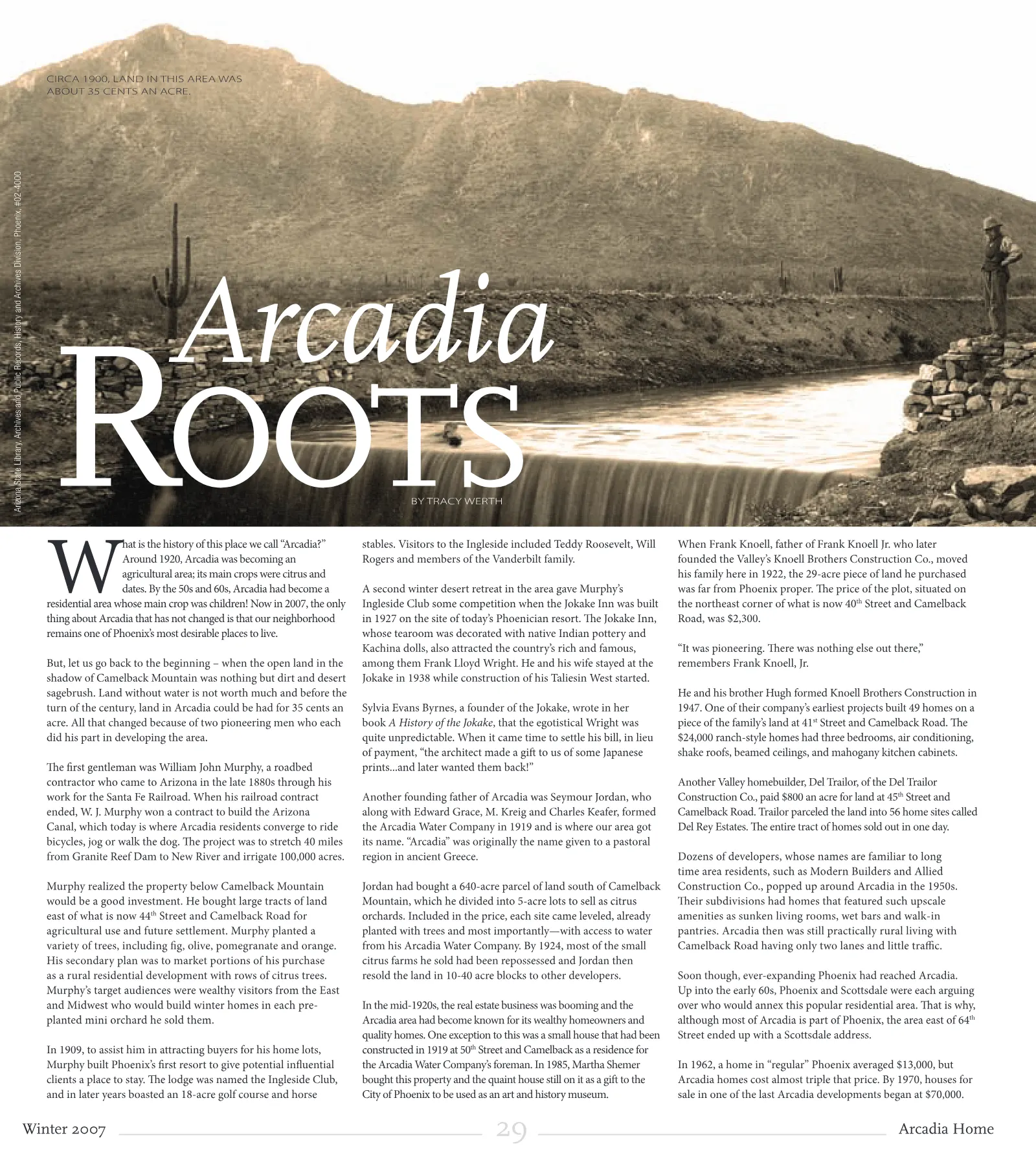
29 Winter 2007 Arcadia Home stables. Visitors to the Ingleside included Teddy Roosevelt, Will Rogers and members of the Vanderbilt family. A second winter desert retreat in the area gave Murphy’s Ingleside Club some competition when the Jokake Inn was built in 1927 on the site of today’s Phoenician resort. The Jokake Inn, whose tearoom was decorated with native Indian pottery and Kachina dolls, also attracted the country’s rich and famous, among them Frank Lloyd Wright. He and his wife stayed at the Jokake in 1938 while construction of his Taliesin West started. Sylvia Evans Byrnes, a founder of the Jokake, wrote in her book A History of the Jokake , that the egotistical Wright was quite unpredictable. When it came time to settle his bill, in lieu of payment, “the architect made a gift to us of some Japanese prints...and later wanted them back!” Another founding father of Arcadia was Seymour Jordan, who along with Edward Grace, M. Kreig and Charles Keafer, formed the Arcadia Water Company in 1919 and is where our area got its name. “Arcadia” was originally the name given to a pastoral region in ancient Greece. Jordan had bought a 640-acre parcel of land south of Camelback Mountain, which he divided into 5-acre lots to sell as citrus orchards. Included in the price, each site came leveled, already planted with trees and most importantly—with access to water from his Arcadia Water Company. By 1924, most of the small citrus farms he sold had been repossessed and Jordan then resold the land in 10-40 acre blocks to other developers. In the mid-1920s, the real estate business was booming and the Arcadia area had become known for its wealthy homeowners and quality homes. One exception to this was a small house that had been constructed in 1919 at 50 th Street and Camelback as a residence for the Arcadia Water Company’s foreman. In 1985, Martha Shemer bought this property and the quaint house still on it as a gift to the City of Phoenix to be used as an art and history museum. W hat is the history of this place we call “Arcadia?” Around 1920, Arcadia was becoming an agricultural area; its main crops were citrus and dates. By the 50s and 60s, Arcadia had become a residential area whose main crop was children! Now in 2007, the only thing about Arcadia that has not changed is that our neighborhood remains one of Phoenix’s most desirable places to live. But, let us go back to the beginning – when the open land in the shadow of Camelback Mountain was nothing but dirt and desert sagebrush. Land without water is not worth much and before the turn of the century, land in Arcadia could be had for 35 cents an acre. All that changed because of two pioneering men who each did his part in developing the area. The fi rst gentleman was William John Murphy, a roadbed contractor who came to Arizona in the late 1880s through his work for the Santa Fe Railroad. When his railroad contract ended, W. J. Murphy won a contract to build the Arizona Canal, which today is where Arcadia residents converge to ride bicycles, jog or walk the dog. The project was to stretch 40 miles from Granite Reef Dam to New River and irrigate 100,000 acres. Murphy realized the property below Camelback Mountain would be a good investment. He bought large tracts of land east of what is now 44 th Street and Camelback Road for agricultural use and future settlement. Murphy planted a variety of trees, including fig, olive, pomegranate and orange. His secondary plan was to market portions of his purchase as a rural residential development with rows of citrus trees. Murphy’s target audiences were wealthy visitors from the East and Midwest who would build winter homes in each pre- planted mini orchard he sold them. In 1909, to assist him in attracting buyers for his home lots, Murphy built Phoenix’s first resort to give potential influential clients a place to stay. The lodge was named the Ingleside Club, and in later years boasted an 18-acre golf course and horse When Frank Knoell, father of Frank Knoell Jr. who later founded the Valley’s Knoell Brothers Construction Co., moved his family here in 1922, the 29-acre piece of land he purchased was far from Phoenix proper. The price of the plot, situated on the northeast corner of what is now 40 th Street and Camelback Road, was $2,300. “It was pioneering. There was nothing else out there,” remembers Frank Knoell, Jr. He and his brother Hugh formed Knoell Brothers Construction in 1947. One of their company’s earliest projects built 49 homes on a piece of the family’s land at 41 st Street and Camelback Road. The $24,000 ranch-style homes had three bedrooms, air conditioning, shake roofs, beamed ceilings, and mahogany kitchen cabinets. Another Valley homebuilder, Del Trailor, of the Del Trailor Construction Co., paid $800 an acre for land at 45 th Street and Camelback Road. Trailor parceled the land into 56 home sites called Del Rey Estates. The entire tract of homes sold out in one day. Dozens of developers, whose names are familiar to long time area residents, such as Modern Builders and Allied Construction Co., popped up around Arcadia in the 1950s. Their subdivisions had homes that featured such upscale amenities as sunken living rooms, wet bars and walk-in pantries. Arcadia then was still practically rural living with Camelback Road having only two lanes and little traffic. Soon though, ever-expanding Phoenix had reached Arcadia. Up into the early 60s, Phoenix and Scottsdale were each arguing over who would annex this popular residential area. That is why, although most of Arcadia is part of Phoenix, the area east of 64 th Street ended up with a Scottsdale address. In 1962, a home in “regular” Phoenix averaged $13,000, but Arcadia homes cost almost triple that price. By 1970, houses for sale in one of the last Arcadia developments began at $70,000. ROOTS Arcadia CIRCA 1900, LAND IN THIS AREA WAS ABOUT 35 CENTS AN ACRE. Arizona State Library, Archives and Public Records, History and Archives Division, Phoenix, #02-4000 BY TRACY WERTH