
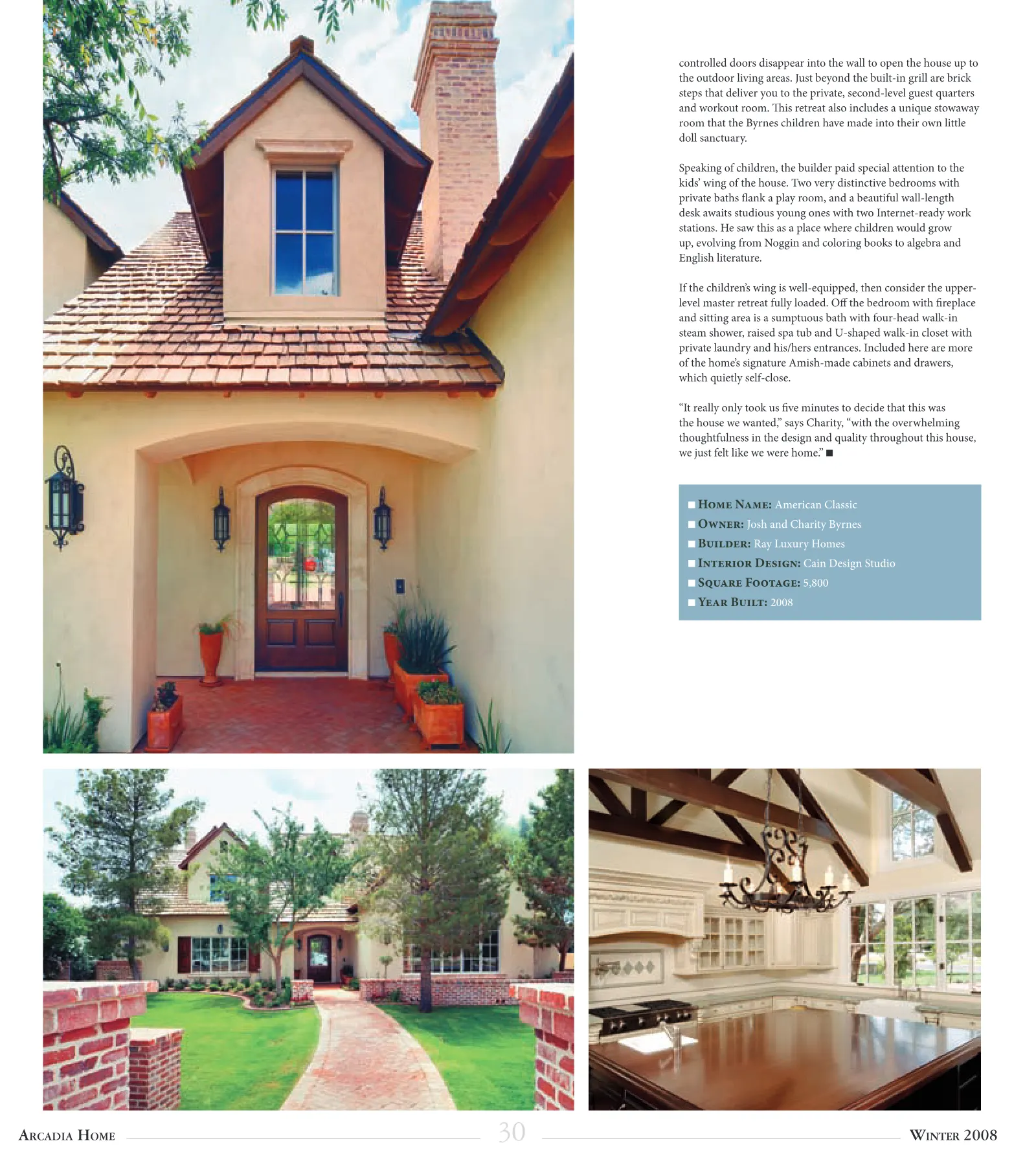
30 Arc A di A Home Winter 2008 controlled doors disappear into the wall to open the house up to the outdoor living areas. Just beyond the built-in grill are brick steps that deliver you to the private, second-level guest quarters and workout room. This retreat also includes a unique stowaway room that the Byrnes children have made into their own little doll sanctuary. Speaking of children, the builder paid special attention to the kids’ wing of the house. Two very distinctive bedrooms with private baths flank a play room, and a beautiful wall-length desk awaits studious young ones with two Internet-ready work stations. He saw this as a place where children would grow up, evolving from Noggin and coloring books to algebra and English literature. If the children’s wing is well-equipped, then consider the upper- level master retreat fully loaded. Off the bedroom with fireplace and sitting area is a sumptuous bath with four-head walk-in steam shower, raised spa tub and U-shaped walk-in closet with private laundry and his/hers entrances. Included here are more of the home’s signature Amish-made cabinets and drawers, which quietly self-close. “It really only took us five minutes to decide that this was the house we wanted,” says Charity, “with the overwhelming thoughtfulness in the design and quality throughout this house, we just felt like we were home.” Home Name: American Classic Owner: Josh and Charity Byrnes Builder: Ray Luxury Homes Interior Design: Cain Design Studio Square Footage: 5,800 Year Built: 2008
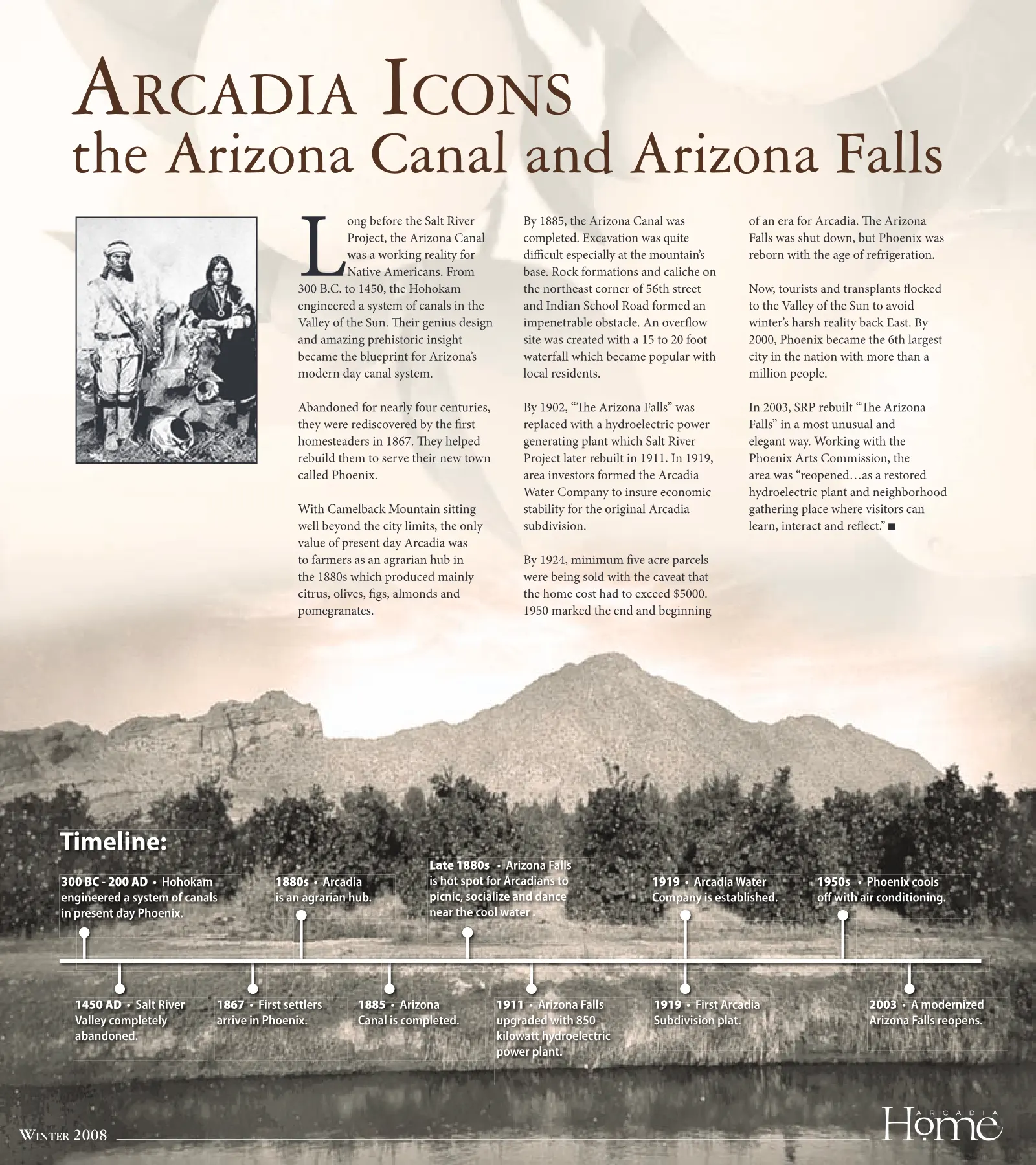
ArcAdiA icons the Arizona Canal and Arizona Falls L ong before the Salt River Project, the Arizona Canal was a working reality for Native Americans. From 300 B.C. to 1450, the Hohokam engineered a system of canals in the Valley of the Sun. Their genius design and amazing prehistoric insight became the blueprint for Arizona’s modern day canal system. Abandoned for nearly four centuries, they were rediscovered by the first homesteaders in 1867. They helped rebuild them to serve their new town called Phoenix. With Camelback Mountain sitting well beyond the city limits, the only value of present day Arcadia was to farmers as an agrarian hub in the 1880s which produced mainly citrus, olives, figs, almonds and pomegranates. By 1885, the Arizona Canal was completed. Excavation was quite difficult especially at the mountain’s base. Rock formations and caliche on the northeast corner of 56th street and Indian School Road formed an impenetrable obstacle. An overflow site was created with a 15 to 20 foot waterfall which became popular with local residents. By 1902, “The Arizona Falls” was replaced with a hydroelectric power generating plant which Salt River Project later rebuilt in 1911. In 1919, area investors formed the Arcadia Water Company to insure economic stability for the original Arcadia subdivision. By 1924, minimum five acre parcels were being sold with the caveat that the home cost had to exceed $5000. 1950 marked the end and beginning of an era for Arcadia. The Arizona Falls was shut down, but Phoenix was reborn with the age of refrigeration. Now, tourists and transplants flocked to the Valley of the Sun to avoid winter’s harsh reality back East. By 2000, Phoenix became the 6th largest city in the nation with more than a million people. In 2003, SRP rebuilt “The Arizona Falls” in a most unusual and elegant way. Working with the Phoenix Arts Commission, the area was “reopened…as a restored hydroelectric plant and neighborhood gathering place where visitors can learn, interact and reflect.” Timeline: 300 BC - 200 AD • Hohokam engineered a system of canals in present day Phoenix. Late 1880s • Arizona Falls is hot spot for Arcadians to picnic, socialize and dance near the cool water . 1880s • Arcadia is an agrarian hub. 1950s • Phoenix cools off with air conditioning. 1919 • Arcadia Water Company is established. 1867 • First settlers arrive in Phoenix. 1450 AD • Salt River Valley completely abandoned. 1885 • Arizona Canal is completed. 1919 • First Arcadia Subdivision plat. 2003 • A modernized Arizona Falls reopens. 1911 • Arizona Falls upgraded with 850 kilowatt hydroelectric power plant. Winter 2008