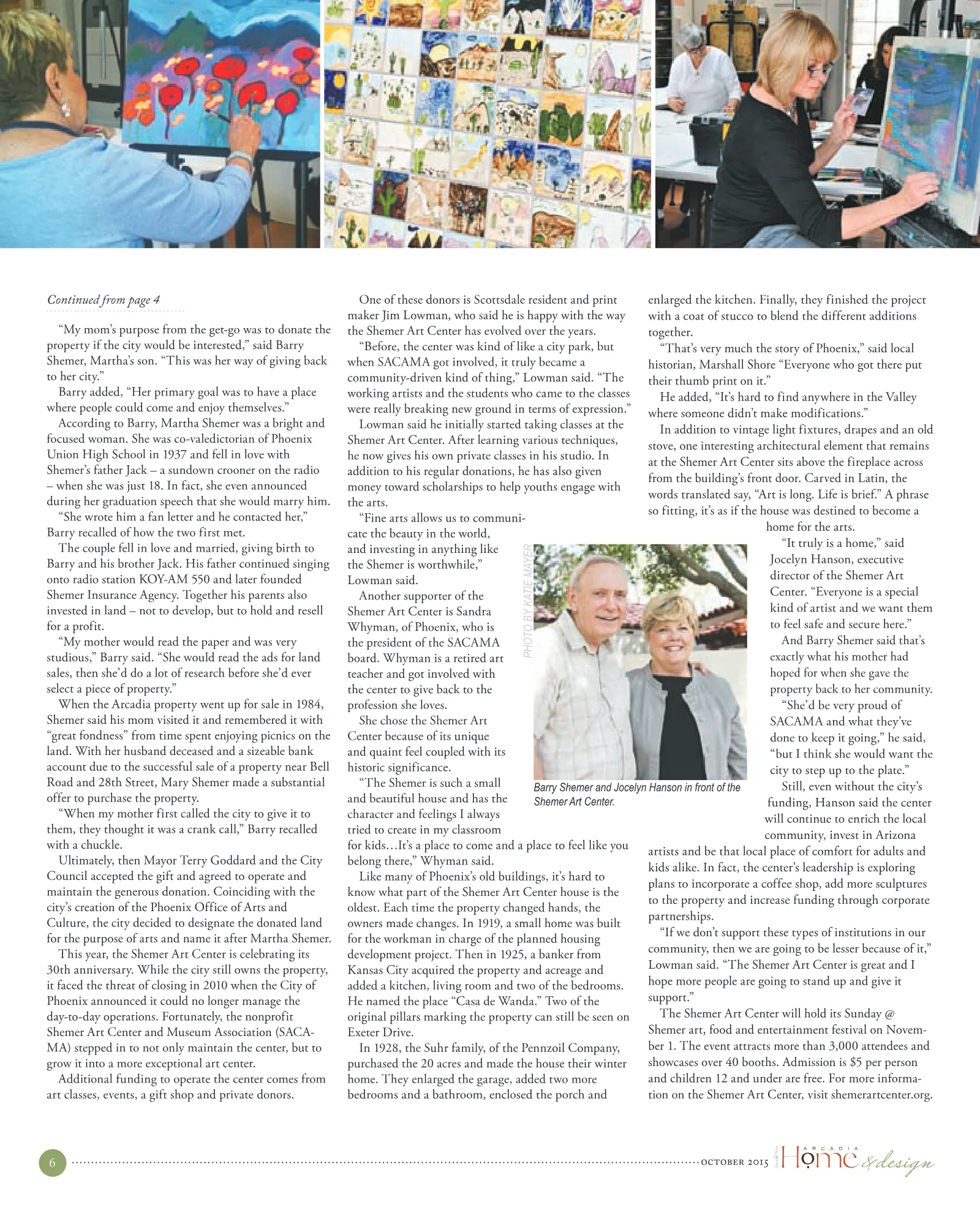
6 october 2015 “My mom’s purpose from the get-go was to donate the property if the city would be interested,” said Barry Shemer, Martha’s son. “This was her way of giving back to her city.” Barry added, “Her primary goal was to have a place where people could come and enjoy themselves.” According to Barry, Martha Shemer was a bright and focused woman. She was co-valedictorian of Phoenix Union High School in 1937 and fell in love with Shemer’s father Jack – a sundown crooner on the radio – when she was just 18. In fact, she even announced during her graduation speech that she would marry him. “She wrote him a fan letter and he contacted her,” Barry recalled of how the two first met. The couple fell in love and married, giving birth to Barry and his brother Jack. His father continued singing onto radio station KOY-AM 550 and later founded Shemer Insurance Agency. Together his parents also invested in land – not to develop, but to hold and resell for a profit. “My mother would read the paper and was very studious,” Barry said. “She would read the ads for land sales, then she’d do a lot of research before she’d ever select a piece of property.” When the Arcadia property went up for sale in 1984, Shemer said his mom visited it and remembered it with “great fondness” from time spent enjoying picnics on the land. With her husband deceased and a sizeable bank account due to the successful sale of a property near Bell Road and 28th Street, Mary Shemer made a substantial offer to purchase the property. “When my mother first called the city to give it to them, they thought it was a crank call,” Barry recalled with a chuckle. Ultimately, then Mayor Terry Goddard and the City Council accepted the gift and agreed to operate and maintain the generous donation. Coinciding with the city’s creation of the Phoenix Office of Arts and Culture, the city decided to designate the donated land for the purpose of arts and name it after Martha Shemer. This year, the Shemer Art Center is celebrating its 30th anniversary. While the city still owns the property, it faced the threat of closing in 2010 when the City of Phoenix announced it could no longer manage the day-to-day operations. Fortunately, the nonprofit Shemer Art Center and Museum Association (SACA- MA) stepped in to not only maintain the center, but to grow it into a more exceptional art center. Additional funding to operate the center comes from art classes, events, a gift shop and private donors. One of these donors is Scottsdale resident and print maker Jim Lowman, who said he is happy with the way the Shemer Art Center has evolved over the years. “Before, the center was kind of like a city park, but when SACAMA got involved, it truly became a community-driven kind of thing,” Lowman said. “The working artists and the students who came to the classes were really breaking new ground in terms of expression.” Lowman said he initially started taking classes at the Shemer Art Center. After learning various techniques, he now gives his own private classes in his studio. In addition to his regular donations, he has also given money toward scholarships to help youths engage with the arts. “Fine arts allows us to communi- cate the beauty in the world, and investing in anything like the Shemer is worthwhile,” Lowman said. Another supporter of the Shemer Art Center is Sandra Whyman, of Phoenix, who is the president of the SACAMA board. Whyman is a retired art teacher and got involved with the center to give back to the profession she loves. She chose the Shemer Art Center because of its unique and quaint feel coupled with its historic significance. “The Shemer is such a small and beautiful house and has the character and feelings I always tried to create in my classroom for kids…It’s a place to come and a place to feel like you belong there,” Whyman said. Like many of Phoenix’s old buildings, it’s hard to know what part of the Shemer Art Center house is the oldest. Each time the property changed hands, the owners made changes. In 1919, a small home was built for the workman in charge of the planned housing development project. Then in 1925, a banker from Kansas City acquired the property and acreage and added a kitchen, living room and two of the bedrooms. He named the place “Casa de Wanda.” Two of the original pillars marking the property can still be seen on Exeter Drive. In 1928, the Suhr family, of the Pennzoil Company, purchased the 20 acres and made the house their winter home. They enlarged the garage, added two more bedrooms and a bathroom, enclosed the porch and enlarged the kitchen. Finally, they finished the project with a coat of stucco to blend the different additions together. “That’s very much the story of Phoenix,” said local historian, Marshall Shore “Everyone who got there put their thumb print on it.” He added, “It’s hard to find anywhere in the Valley where someone didn’t make modifications.” In addition to vintage light fixtures, drapes and an old stove, one interesting architectural element that remains at the Shemer Art Center sits above the fireplace across from the building’s front door. Carved in Latin, the words translated say, “Art is long. Life is brief.” A phrase so fitting, it’s as if the house was destined to become a home for the arts. “It truly is a home,” said Jocelyn Hanson, executive director of the Shemer Art Center. “Everyone is a special kind of artist and we want them to feel safe and secure here.” And Barry Shemer said that’s exactly what his mother had hoped for when she gave the property back to her community. “She’d be very proud of SACAMA and what they’ve done to keep it going,” he said, “but I think she would want the city to step up to the plate.” Still, even without the city’s funding, Hanson said the center will continue to enrich the local community, invest in Arizona artists and be that local place of comfort for adults and kids alike. In fact, the center’s leadership is exploring plans to incorporate a coffee shop, add more sculptures to the property and increase funding through corporate partnerships. “If we don’t support these types of institutions in our community, then we are going to be lesser because of it,” Lowman said. “The Shemer Art Center is great and I hope more people are going to stand up and give it support.” The Shemer Art Center will hold its Sunday @ Shemer art, food and entertainment festival on Novem- ber 1. The event attracts more than 3,000 attendees and showcases over 40 booths. Admission is $5 per person and children 12 and under are free. For more informa- tion on the Shemer Art Center, visit shemerartcenter.org. Continued from page 4 Barry Shemer and Jocelyn Hanson in front of the Shemer Art Center. PHOTO BY KATIE MAYER