
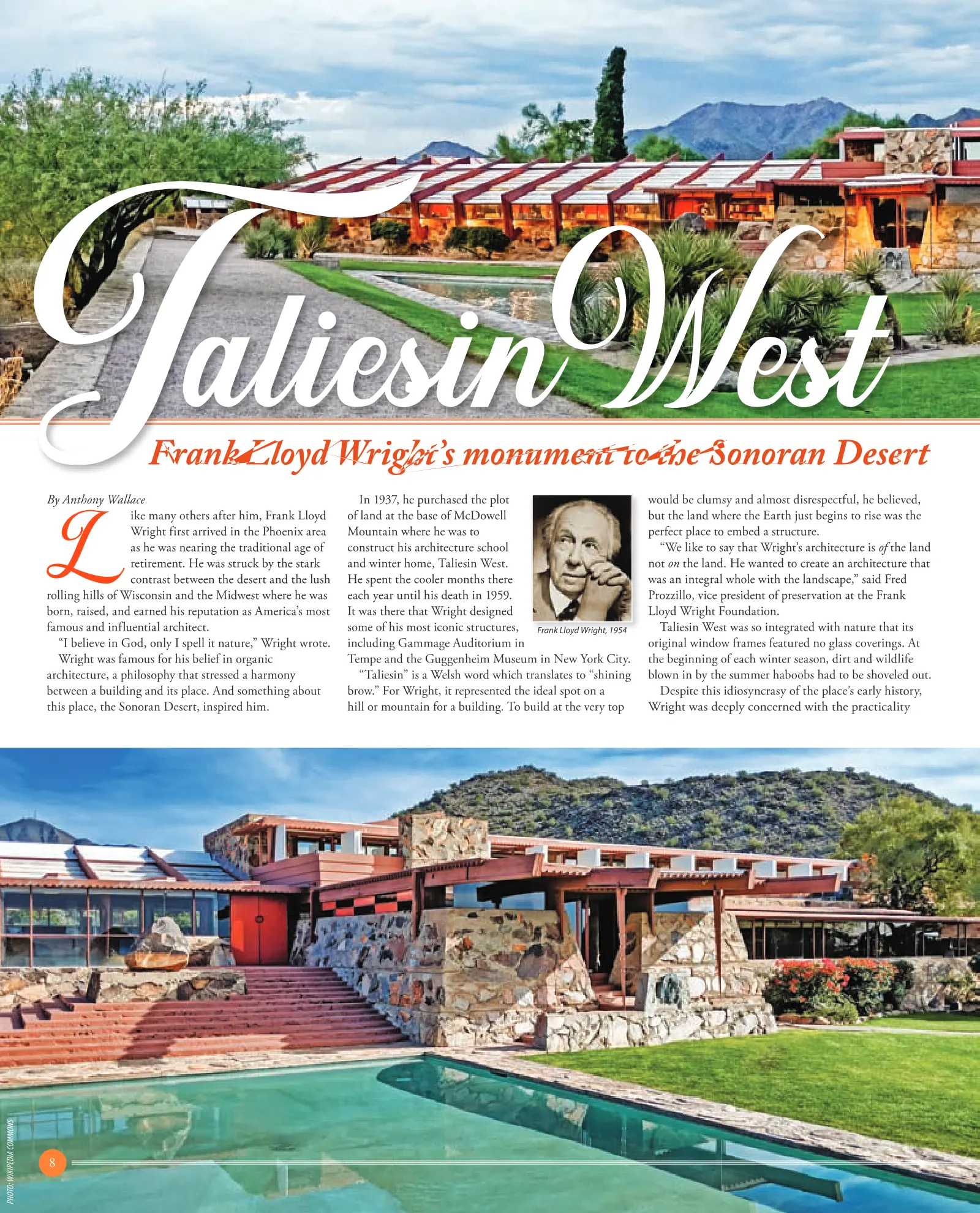
8 By Anthony Wallace ike many others after him, Frank Lloyd Wright first arrived in the Phoenix area as he was nearing the traditional age of retirement. He was struck by the stark contrast between the desert and the lush rolling hills of Wisconsin and the Midwest where he was born, raised, and earned his reputation as America’s most famous and influential architect. “I believe in God, only I spell it nature,” Wright wrote. Wright was famous for his belief in organic architecture, a philosophy that stressed a harmony between a building and its place. And something about this place, the Sonoran Desert, inspired him. In 1937, he purchased the plot of land at the base of McDowell Mountain where he was to construct his architecture school and winter home, Taliesin West. He spent the cooler months there each year until his death in 1959. It was there that Wright designed some of his most iconic structures, including Gammage Auditorium in Tempe and the Guggenheim Museum in New York City. “Taliesin” is a Welsh word which translates to “shining brow.” For Wright, it represented the ideal spot on a hill or mountain for a building. To build at the very top would be clumsy and almost disrespectful, he believed, but the land where the Earth just begins to rise was the perfect place to embed a structure. “We like to say that Wright’s architecture is of the land not on the land. He wanted to create an architecture that was an integral whole with the landscape,” said Fred Prozzillo, vice president of preservation at the Frank Lloyd Wright Foundation. Taliesin West was so integrated with nature that its original window frames featured no glass coverings. At the beginning of each winter season, dirt and wildlife blown in by the summer haboobs had to be shoveled out. Despite this idiosyncrasy of the place’s early history, Wright was deeply concerned with the practicality Frank Lloyd Wright’s monument to the Sonoran Desert Frank Lloyd Wright’s monument to the Sonoran Desert TaliesinWest PHOTO: WIKIPEDIA COMMONS Frank Lloyd Wright, 1954
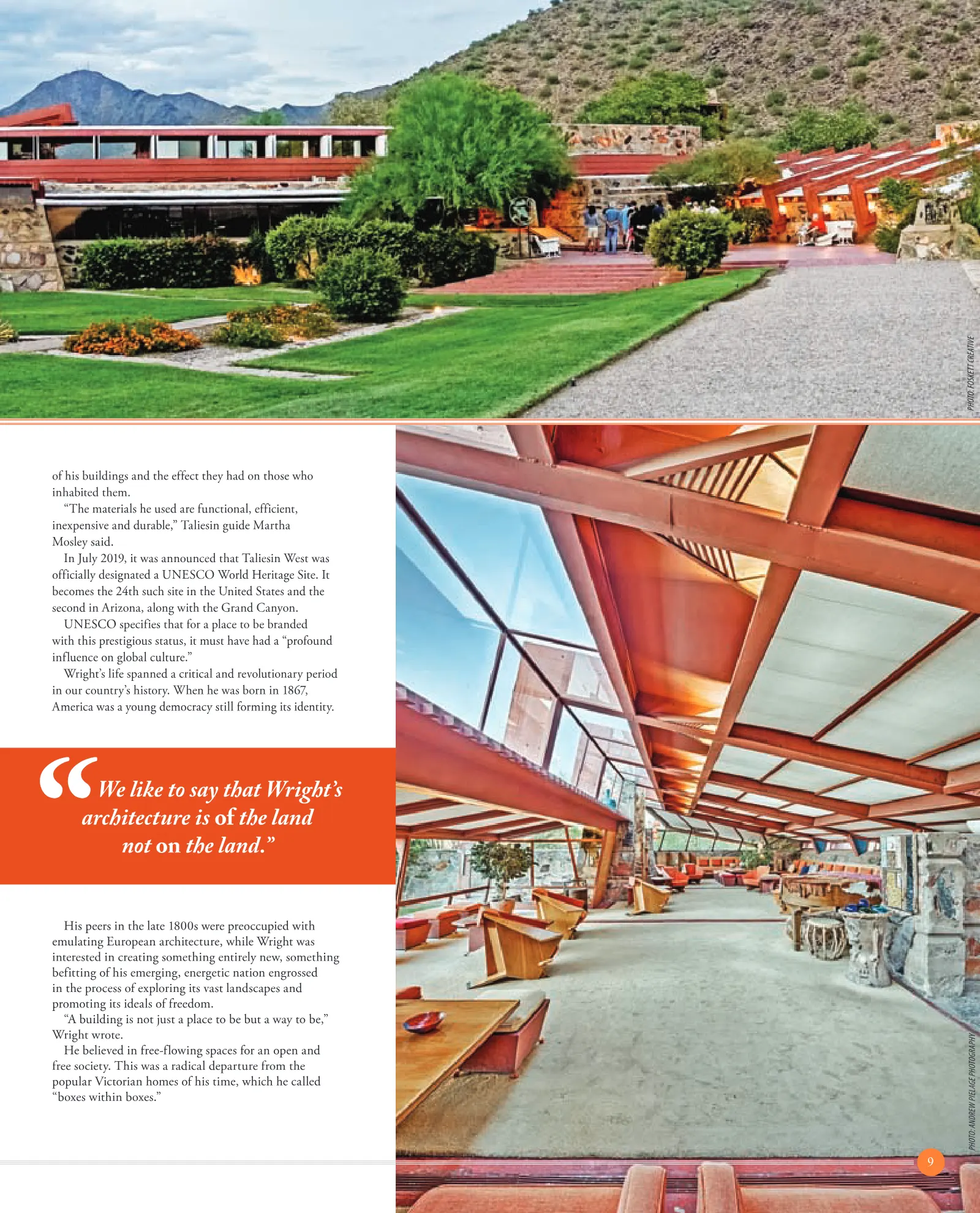
of his buildings and the effect they had on those who inhabited them. “The materials he used are functional, efficient, inexpensive and durable,” Taliesin guide Martha Mosley said. In July 2019, it was announced that Taliesin West was officially designated a UNESCO World Heritage Site. It becomes the 24th such site in the United States and the second in Arizona, along with the Grand Canyon. UNESCO specifies that for a place to be branded with this prestigious status, it must have had a “profound influence on global culture.” Wright’s life spanned a critical and revolutionary period in our country’s history. When he was born in 1867, America was a young democracy still forming its identity. His peers in the late 1800s were preoccupied with emulating European architecture, while Wright was interested in creating something entirely new, something befitting of his emerging, energetic nation engrossed in the process of exploring its vast landscapes and promoting its ideals of freedom. “A building is not just a place to be but a way to be,” Wright wrote. He believed in free-flowing spaces for an open and free society. This was a radical departure from the popular Victorian homes of his time, which he called “boxes within boxes.” We like to say that Wright’s architecture is of the land not on the land.” PHOTO: FOSKETT CREATIVE PHOTO: ANDREW PIELAGE PHOTOGRAPHY 9