
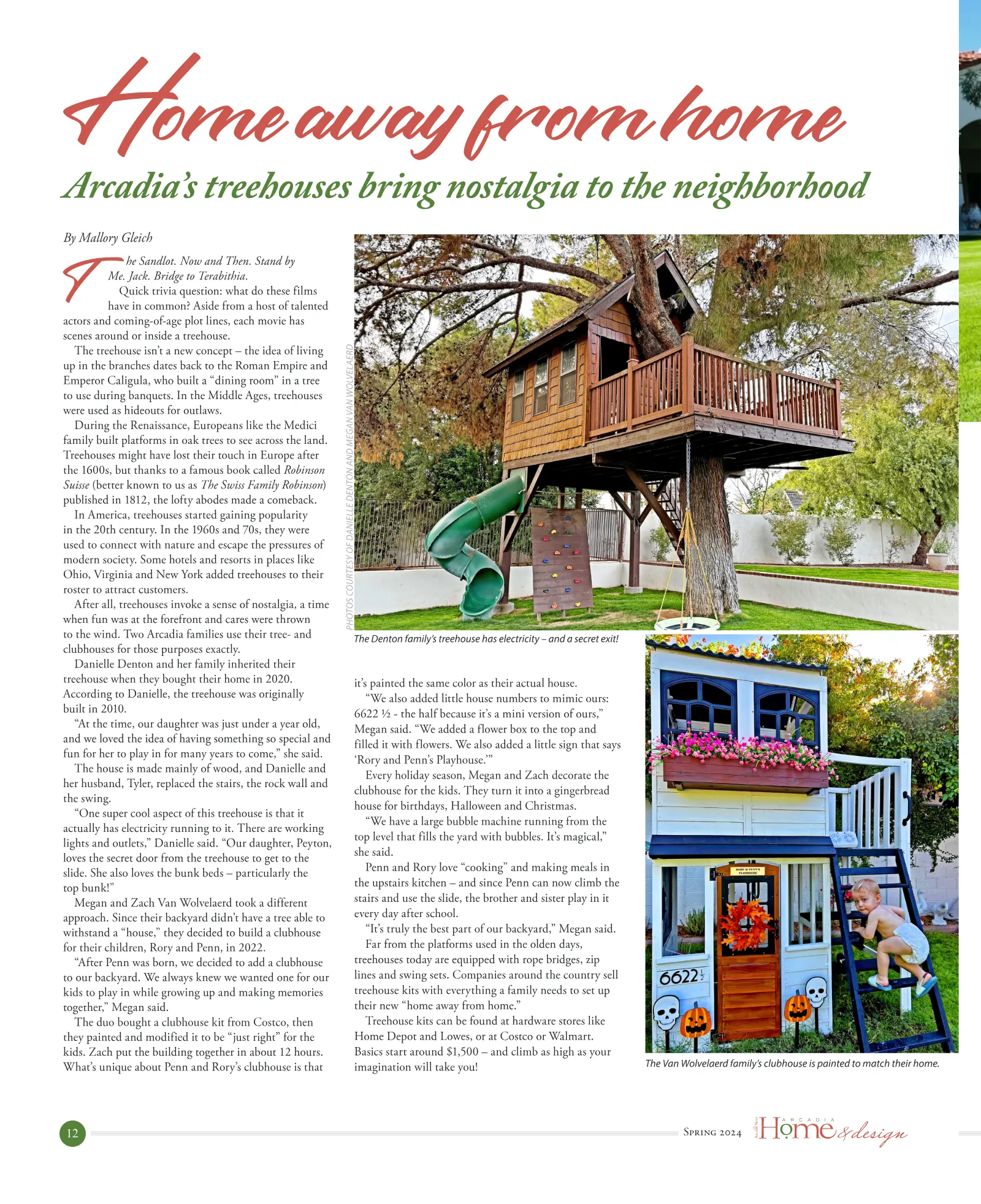
12 S pring 2024 By Mallory Gleich he Sandlot. Now and Then. Stand by Me. Jack. Bridge to Terabithia. Quick trivia question: what do these films have in common? Aside from a host of talented actors and coming-of-age plot lines, each movie has scenes around or inside a treehouse. The treehouse isn’t a new concept – the idea of living up in the branches dates back to the Roman Empire and Emperor Caligula, who built a “dining room” in a tree to use during banquets. In the Middle Ages, treehouses were used as hideouts for outlaws. During the Renaissance, Europeans like the Medici family built platforms in oak trees to see across the land. Treehouses might have lost their touch in Europe after the 1600s, but thanks to a famous book called Robinson Suisse (better known to us as The Swiss Family Robinson ) published in 1812, the lofty abodes made a comeback. In America, treehouses started gaining popularity in the 20th century. In the 1960s and 70s, they were used to connect with nature and escape the pressures of modern society. Some hotels and resorts in places like Ohio, Virginia and New York added treehouses to their roster to attract customers. After all, treehouses invoke a sense of nostalgia, a time when fun was at the forefront and cares were thrown to the wind. Two Arcadia families use their tree- and clubhouses for those purposes exactly. Danielle Denton and her family inherited their treehouse when they bought their home in 2020. According to Danielle, the treehouse was originally built in 2010. “At the time, our daughter was just under a year old, and we loved the idea of having something so special and fun for her to play in for many years to come,” she said. The house is made mainly of wood, and Danielle and her husband, Tyler, replaced the stairs, the rock wall and the swing. “One super cool aspect of this treehouse is that it actually has electricity running to it. There are working lights and outlets,” Danielle said. “Our daughter, Peyton, loves the secret door from the treehouse to get to the slide. She also loves the bunk beds – particularly the top bunk!” Megan and Zach Van Wolvelaerd took a different approach. Since their backyard didn’t have a tree able to withstand a “house,” they decided to build a clubhouse for their children, Rory and Penn, in 2022. “After Penn was born, we decided to add a clubhouse to our backyard. We always knew we wanted one for our kids to play in while growing up and making memories together,” Megan said. The duo bought a clubhouse kit from Costco, then they painted and modified it to be “just right” for the kids. Zach put the building together in about 12 hours. What’s unique about Penn and Rory’s clubhouse is that it’s painted the same color as their actual house. “We also added little house numbers to mimic ours: 6622 ½ - the half because it’s a mini version of ours,” Megan said. “We added a flower box to the top and filled it with flowers. We also added a little sign that says ‘Rory and Penn’s Playhouse.’” Every holiday season, Megan and Zach decorate the clubhouse for the kids. They turn it into a gingerbread house for birthdays, Halloween and Christmas. “We have a large bubble machine running from the top level that fills the yard with bubbles. It’s magical,” she said. Penn and Rory love “cooking” and making meals in the upstairs kitchen – and since Penn can now climb the stairs and use the slide, the brother and sister play in it every day after school. “It’s truly the best part of our backyard,” Megan said. Far from the platforms used in the olden days, treehouses today are equipped with rope bridges, zip lines and swing sets. Companies around the country sell treehouse kits with everything a family needs to set up their new “home away from home.” Treehouse kits can be found at hardware stores like Home Depot and Lowes, or at Costco or Walmart. Basics start around $1,500 – and climb as high as your imagination will take you! Arcadia’s treehouses bring nostalgia to the neighborhood Home away from home T T The Denton family’s treehouse has electricity – and a secret exit! The Van Wolvelaerd family’s clubhouse is painted to match their home. PHOTOS COURTESY OF DANIELLE DENTON AND MEGAN VAN WOLVELAERD
13 By Eric Warchol esert soil can make growing trees and shrubs a challenge, as soil is where everything starts for a plant. Thankfully, plant growers can manipulate soil to provide a better growing medium for non-native plants. Healthy soil = healthy plants. Our caliche (a mineral deposit of gravel, sand, and nitrates found in southwest climates) contains a calcium carbonate that “cements” the soil together. Anyone who has tried to dig a hole in the ground in Arizona knows this well. This is not the only problem with trying to grow plants in clay. Our soils have high salts that are low in organic matter and high in alkalinity (pH 8 and above). Most plants – especially citrus – like neutral or slightly acidic soil conditions (pH 7 is neutral). Native plants have adapted to these soil conditions. When planning a landscape, there are plenty to choose from: palo species, mesquites, agave and yucca are a few examples. One topic that has recently come to light is non- native trees that were thriving in years past are slowly declining. Clay soil and water contain salts, is high in pH, has limited organic matter and lack of proper drainage or water penetration. Other offenders are the weaker monsoon storms of recent years and an increase in temperatures during the summer. Trees and shrubs are struggling for many reasons, but the good news is they can be helped. Every year, plants utilize what is in the soil; if we don’t replenish what the plants use, they will struggle to survive. At a bare minimum, most should be fertilized in spring and fall – citrus and flowers (like roses) should be fertilized three times a year. One of the biggest concerns is the lack of proper watering and salt buildup in the soil. Symptoms show as browning along leaf edges and tips and premature leaf drop. One important thing to do is water plants slowly and deeply to get down to the roots. Use a long screwdriver (or equivalent) and push it into the soil close to the emitter after watering – the tool should go down easily two feet into the ground for trees. If it doesn’t, water longer. Leach salts from the soil by watering twice as long as normal every six months to push the salts below the roots. When you fertilize, make sure there is some soil sulfur in your product if you’re using granular fertilizer. When using granular fertilizers (these encourage soil nutrient levels and create healthy turf), use the proper amount – typically a lot more than you think. Professionals usually use liquid fertilizers mixed with a pH-reducing product for quicker absorption into the plants. At A to Z Tree and Turf, we have Plant Healthcare Programs that provide plants with what they need at specific times of the year. Our citrus treatment includes fertilizers, pH reducers, soil amendments, biostimulants, and a biological preventative fungicide all mixed and applied to the soil. Make sure you add organic matter to your lawn. Although granite has a nice, clean appearance in a yard, there is no benefit to the roots of your valuable landscape plants or the soil. I recommend placing a border: rocks, steel edging, etc. and adding mulch around your trees, especially citrus. The mulch holds water better than granite, cools the roots during the summer, breaks down over time to add organic matter to the soil and can reduce soil compaction. Mulch is a great benefit to all plants but should not be placed directly against the trunk and will need to be refreshed as it breaks down – yearly is typically sufficient. Proper watering, lowering the soil pH, fertilizing at the correct times of the year with the proper nutrition and adding organic matter will benefit the landscape and plants. Most of the dead or dying plants we see in winter result from the temps and lack of humidity during the summer. We are trying our best – professionals and homeowners alike – to help plants grow and thrive, but the adage remains true: “Right plant in the right place.” How to improve Arizona’s soil for plants and trees TheScience ofSoil D D . Eric Warchol is the head of A to Z Tree and Turf ’s Plant Healthcare division. His background includes vegetation management, tree care and golf course management. eric@atoztreeandturf.com