

Spring 2025 12 By Mallory Gleich I he consequences of being exposed to anticoagulant rodenticides are severe for the hawks, vultures, eagles, falcons, and owls that call the Valley home. In Arcadia, where populations of roof rats run rampant in the spring – thanks to an abundance of citrus – the use of rodenticides, while helpful in ridding the neighborhood of pests, are unintentionally killing owls and other predatory birds that play a vital role in keeping rodent populations in check. Arcadia News spoke to four specialists who discussed the issues surrounding rodenticides and what homeowners can do to keep the pest population down and the ecosystem healthy. WHAT ARE RODENTICIDES? Rodenticides are commonly used to control rodent populations, particularly when they invade homes or cause property damage. “These chemicals, especially anticoagulant rodenticides (ARs), cause internal bleeding which can lead to secondary poisoning of any wildlife that might prey on them,” Owens-Viani said. “Where there are people, there are rodents; it is that simple,” Kern said. “With our dry dwellings, food storage, and disruption of natural habitats, we create ideal conditions for many mice, rats, and other species which are undesirable in our homes.” Rodenticides are often employed to manage rodents that thrive in human habitats, where food storage and dry spaces create ideal conditions. Unfortunately the toxins can spread through the food chain, affecting scavengers and pets. “A killing strategy produces dead carcasses that are diseased and dangerous,” Dr. Loretta Mayer said. “As they’ve been developed to be more lethal with less product, the current rodenticides used today lead to slow rodent deaths and provide easy prey for raptors and urban wildlife such as coyotes, foxes, raccoons, and domestic animals like dogs and cats.” Despite their widespread use for centuries, rodenticides have limitations – such as rodents’ rapid reproduction rates. Additionally, their use has led to significant infrastructure damage, including fire hazards from rodents chewing wires. In response to these risks, regions like California and British Columbia have restricted rodenticide use, and other areas are considering similar legislation. WHAT ARE THE EFFECTS? When these birds eat rodents that have ingested ARs, they may suffer from internal bleeding, organ failure, sensory loss, and confusion. These effects can leave them unable to hunt, causing Cynthia Hopf-Dennis Clinical Wildlife Veterinarian; faculty at Cornell University Hardy Kern American Bird Conservancy Expert Lisa Owens-Viani Founder of Raptors Are the Solution nonprofit Dr. Loretta Mayer Co-founder of the Wisdom Good Works nonprofit Protecting Birds of Prey Arcadia neighbors call for safer pest control solutions Protecting Protecting Birds Protecting Birds Protecting of Prey Arcadia neighbors call for safer pest control solutions Protecting Protecting Arcadia neighbors call for safer pest control solutions
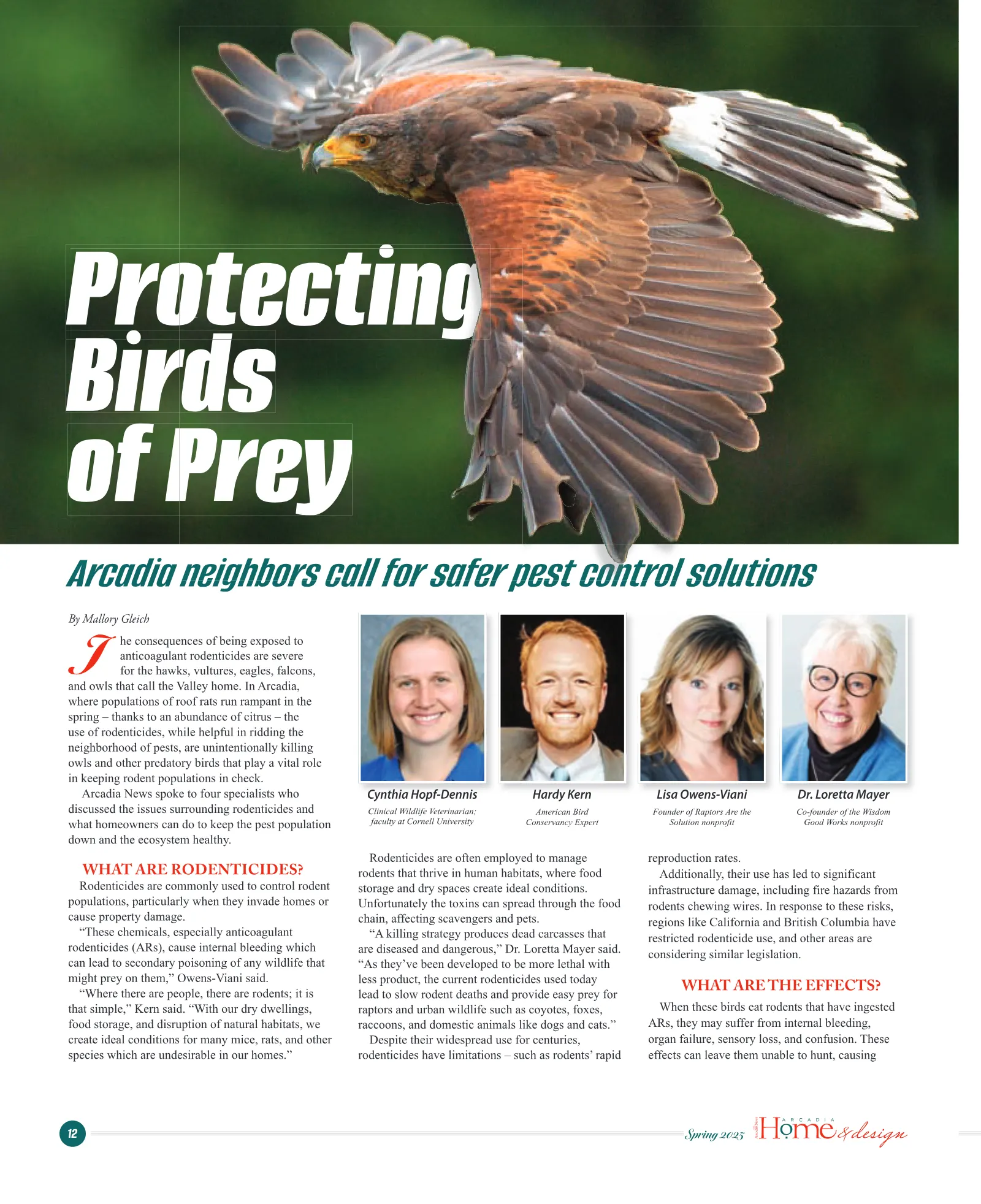
13 them to collide with structures, become more vulnerable to predators, or fall ill due to weakened immune systems. For species like Harris's Hawks (pictured on page 12), such poisoning can severely impact their survival. As it accumulates in the birds over time, it leads to lethargy and eventual death. HOW DO BIRDS HELP? Birds of prey are nature’s best rodent control. They can eat upwards of thousands yearly and also help control other populations of wildlife we may consider pests. “Birds of prey are typically territorial as well, meaning that when there are healthy populations of owls or hawks in an area, they encourage the spread of raptors into other areas too, helping scale-up their control operations,” Hardy said. "Human communities benefit from natural pest control in our homes, parks, businesses, and schools.” WHAT CAN WE DO? The most obvious answer here is to stop using poison to get rid of pests. Hopf-Dennis and Mayer also mentioned that supporting the local ecosystem involves several actions to minimize harm to wildlife and promote healthy habitats. These include keeping areas clean to prevent animals from consuming harmful trash, securely storing waste to avoid attracting wildlife and reducing pesticide and rodenticide use to protect insects, birds, mammals, and raptors. “Professional pest control companies are increasingly specializing in exclusion, which involves finding out how vermin are getting into a structure and using hardware cloth, sealing up holes, or other means to prevent them from regaining access,” Owens-Viani said. It is also crucial to provide perching, nesting, and hiding spaces within trees and plants and plant native flowers to support pollinators. State wildlife agencies may offer specific guidelines for local ecosystems. “There are live traps that can be utilized for rodents, but these should be checked regularly and food and water should be provided inside them,” Hopf-Dennis said. Snap traps may not be the most popular option, but they can work on a small scale. These should only be set up inside houses and in a place that is safe from pets and children – but this goes for all rodent interventions. Arcadia neighbor Carrie Aaron built a screech owl house in her front yard. “These houses can encourage the natural exterminators to settle in our neighborhoods. A single family of owls can consume hundreds of rodents in a single season,” Aaron said. If you suspect a bird of prey has been poisoned, the first thing you should do is call a local wildlife rehabilitator – like Liberty Wildlife or Southwest Wildlife Conservation Center – and do not attempt to handle the bird yourself. HOW DO WE BUILD AWARENESS? “Only when we know better can we do better. Many people do not realize that rodenticides impact species outside of those they target,” Kern said. “Although people think of birds of prey as ‘tough,’ they are actually quite vulnerable – only 30-50 percent of all raptors make it through their first year,” Viani-Owens said. “They face many threats, from climate change and loss of habitat to people shooting and trapping them, to wind and solar power impacts, to being harmed by razor and barbed wire…the list goes on.” At the very least, anticoagulant rodenticides are one thing we can do something about now. By not using them, we can reduce the threat of secondary poisoning. According to Kern, Americans currently use more than one billion pounds of pesticides per year in the United States, which exacts a cost on our wildlife. By working with nature instead of against it, we can create healthier habitats and less toxic environments for wildlife. THE ARCADIAN a r c a d i a n P H X . c o m STOP RENTING START OWNING Schedule a Tour! STARTING IN THE $600s PURCHASING A HOME IN ARCADIA IS EASIER THAN YOU MIGHT THINK!