
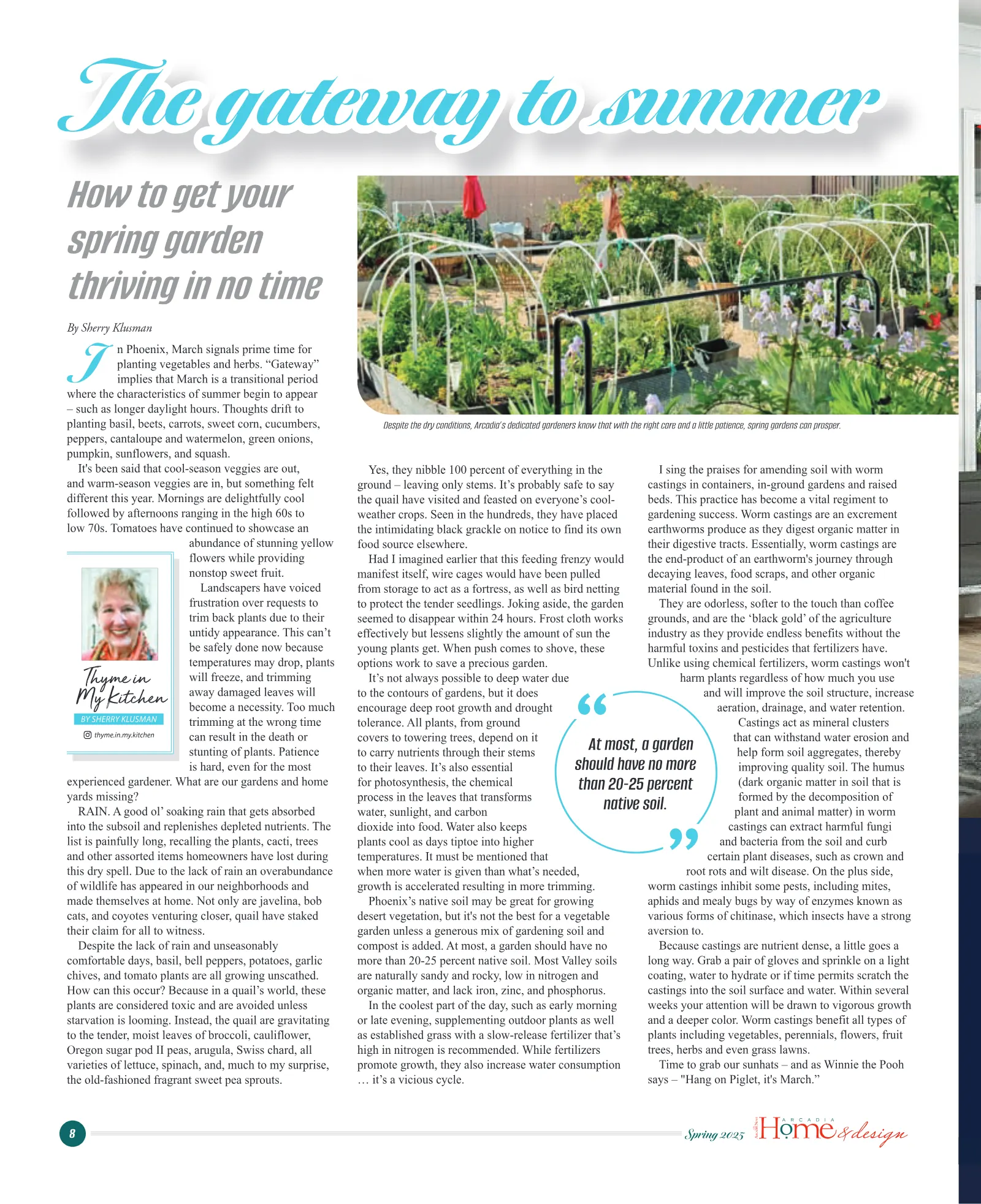

8 Spring 2025 By Sherry Klusman I n Phoenix, March signals prime time for planting vegetables and herbs. “Gateway” implies that March is a transitional period where the characteristics of summer begin to appear – such as longer daylight hours. Thoughts drift to planting basil, beets, carrots, sweet corn, cucumbers, peppers, cantaloupe and watermelon, green onions, pumpkin, sunflowers, and squash. It's been said that cool-season veggies are out, and warm-season veggies are in, but something felt different this year. Mornings are delightfully cool followed by afternoons ranging in the high 60s to low 70s. Tomatoes have continued to showcase an abundance of stunning yellow flowers while providing nonstop sweet fruit. Landscapers have voiced frustration over requests to trim back plants due to their untidy appearance. This can’t be safely done now because temperatures may drop, plants will freeze, and trimming away damaged leaves will become a necessity. Too much trimming at the wrong time can result in the death or stunting of plants. Patience is hard, even for the most experienced gardener. What are our gardens and home yards missing? RAIN. A good ol’ soaking rain that gets absorbed into the subsoil and replenishes depleted nutrients. The list is painfully long, recalling the plants, cacti, trees and other assorted items homeowners have lost during this dry spell. Due to the lack of rain an overabundance of wildlife has appeared in our neighborhoods and made themselves at home. Not only are javelina, bob cats, and coyotes venturing closer, quail have staked their claim for all to witness. Despite the lack of rain and unseasonably comfortable days, basil, bell peppers, potatoes, garlic chives, and tomato plants are all growing unscathed. How can this occur? Because in a quail’s world, these plants are considered toxic and are avoided unless starvation is looming. Instead, the quail are gravitating to the tender, moist leaves of broccoli, cauliflower, Oregon sugar pod II peas, arugula, Swiss chard, all varieties of lettuce, spinach, and, much to my surprise, the old-fashioned fragrant sweet pea sprouts. Yes, they nibble 100 percent of everything in the ground – leaving only stems. It’s probably safe to say the quail have visited and feasted on everyone’s cool- weather crops. Seen in the hundreds, they have placed the intimidating black grackle on notice to find its own food source elsewhere. Had I imagined earlier that this feeding frenzy would manifest itself, wire cages would have been pulled from storage to act as a fortress, as well as bird netting to protect the tender seedlings. Joking aside, the garden seemed to disappear within 24 hours. Frost cloth works effectively but lessens slightly the amount of sun the young plants get. When push comes to shove, these options work to save a precious garden. It’s not always possible to deep water due to the contours of gardens, but it does encourage deep root growth and drought tolerance. All plants, from ground covers to towering trees, depend on it to carry nutrients through their stems to their leaves. It’s also essential for photosynthesis, the chemical process in the leaves that transforms water, sunlight, and carbon dioxide into food. Water also keeps plants cool as days tiptoe into higher temperatures. It must be mentioned that when more water is given than what’s needed, growth is accelerated resulting in more trimming. Phoenix’s native soil may be great for growing desert vegetation, but it's not the best for a vegetable garden unless a generous mix of gardening soil and compost is added. At most, a garden should have no more than 20-25 percent native soil. Most Valley soils are naturally sandy and rocky, low in nitrogen and organic matter, and lack iron, zinc, and phosphorus. In the coolest part of the day, such as early morning or late evening, supplementing outdoor plants as well as established grass with a slow-release fertilizer that’s high in nitrogen is recommended. While fertilizers promote growth, they also increase water consumption … it’s a vicious cycle. I sing the praises for amending soil with worm castings in containers, in-ground gardens and raised beds. This practice has become a vital regiment to gardening success. Worm castings are an excrement earthworms produce as they digest organic matter in their digestive tracts. Essentially, worm castings are the end-product of an earthworm's journey through decaying leaves, food scraps, and other organic material found in the soil. They are odorless, softer to the touch than coffee grounds, and are the ‘black gold’ of the agriculture industry as they provide endless benefits without the harmful toxins and pesticides that fertilizers have. Unlike using chemical fertilizers, worm castings won't harm plants regardless of how much you use and will improve the soil structure, increase aeration, drainage, and water retention. Castings act as mineral clusters that can withstand water erosion and help form soil aggregates, thereby improving quality soil. The humus (dark organic matter in soil that is formed by the decomposition of plant and animal matter) in worm castings can extract harmful fungi and bacteria from the soil and curb certain plant diseases, such as crown and root rots and wilt disease. On the plus side, worm castings inhibit some pests, including mites, aphids and mealy bugs by way of enzymes known as various forms of chitinase, which insects have a strong aversion to. Because castings are nutrient dense, a little goes a long way. Grab a pair of gloves and sprinkle on a light coating, water to hydrate or if time permits scratch the castings into the soil surface and water. Within several weeks your attention will be drawn to vigorous growth and a deeper color. Worm castings benefit all types of plants including vegetables, perennials, flowers, fruit trees, herbs and even grass lawns. Time to grab our sunhats – and as Winnie the Pooh says – "Hang on Piglet, it's March.” The gateway to summer The gateway to summer How to get your spring garden thriving in no time Despite the dry conditions, Arcadia’s dedicated gardeners know that with the right care and a little patience, spring gardens can prosper. BY SHERRY KLUSMAN thyme.in.my.kitchen At most, a garden should have no more than 20-25 percent native soil.
AT LASTING IMPRESSIONS WE SPECIALIZE IN: • Replacement Windows • New Construction Windows • Multi-Slide - Bi-Folding Doors • Entry, French & Patio Doors • Barn Doors & Hardware • Interior Doors & Trim • Velux Skylight and Sun Tunnels • Security Doors & Retractable Screens Let the Outside In... Mon-Thurs 8:30AM-5PM | Fri 8:30AM-4PM | Sat 9:00AM-2PM 4454 East Thomas Road, Phoenix, AZ 85018 602.508.0800 | liwindow.com CALL TODAY FOR A FREE IN HOME ESTIMATE ROC# 179513 Stop by our showroom to view the latest trends! Up to $1,500 off off See your sales rep for details.