
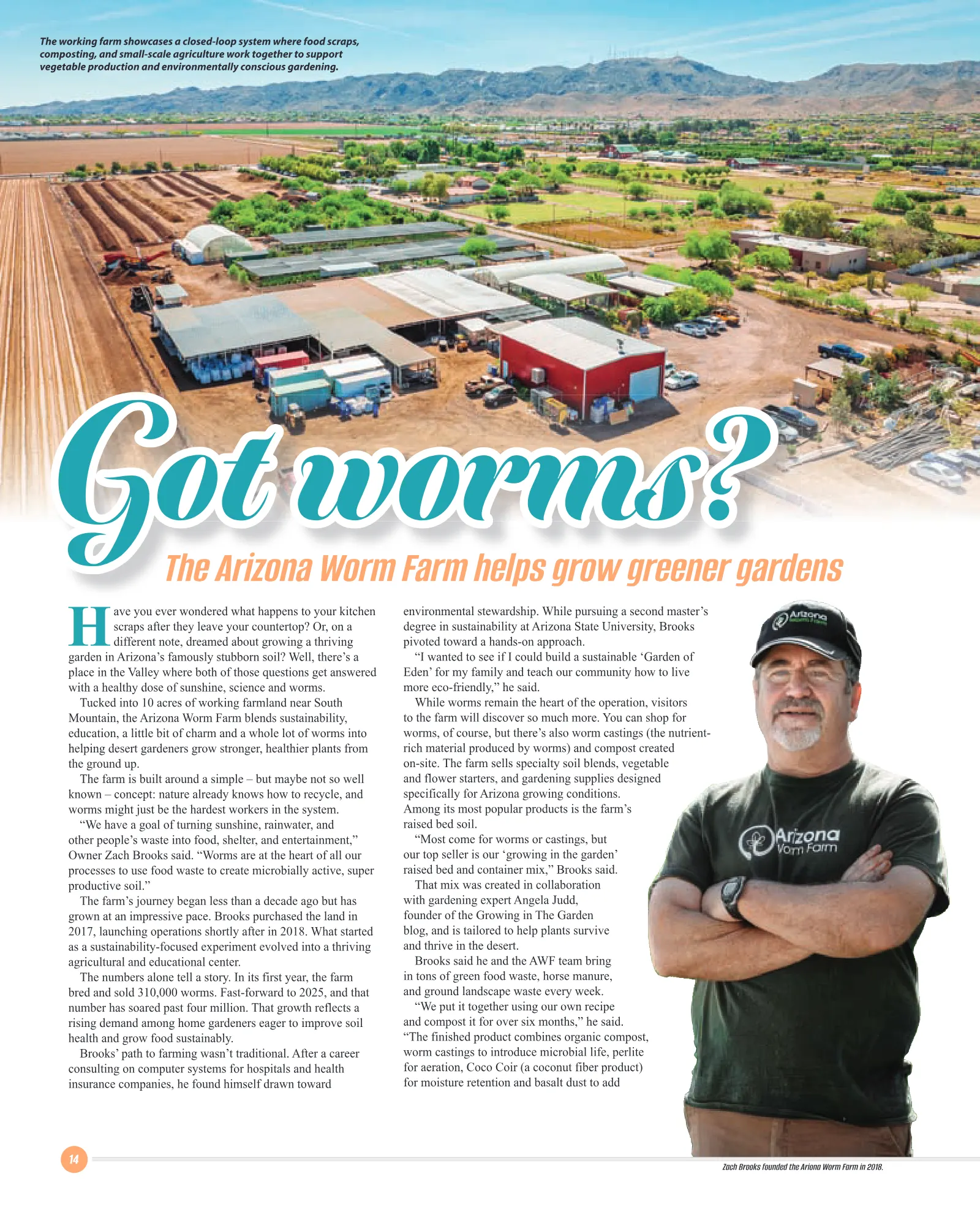
Got worm ? H ave you ever wondered what happens to your kitchen scraps after they leave your countertop? Or, on a different note, dreamed about growing a thriving garden in Arizona’s famously stubborn soil? Well, there’s a place in the Valley where both of those questions get answered with a healthy dose of sunshine, science and worms. Tucked into 10 acres of working farmland near South Mountain, the Arizona Worm Farm blends sustainability, education, a little bit of charm and a whole lot of worms into helping desert gardeners grow stronger, healthier plants from the ground up. The farm is built around a simple – but maybe not so well known – concept: nature already knows how to recycle, and worms might just be the hardest workers in the system. “We have a goal of turning sunshine, rainwater, and other people’s waste into food, shelter, and entertainment,” Owner Zach Brooks said. “Worms are at the heart of all our processes to use food waste to create microbially active, super productive soil.” The farm’s journey began less than a decade ago but has grown at an impressive pace. Brooks purchased the land in 2017, launching operations shortly after in 2018. What started as a sustainability-focused experiment evolved into a thriving agricultural and educational center. The numbers alone tell a story. In its first year, the farm bred and sold 310,000 worms. Fast-forward to 2025, and that number has soared past four million. That growth reflects a rising demand among home gardeners eager to improve soil health and grow food sustainably. Brooks’ path to farming wasn’t traditional. After a career consulting on computer systems for hospitals and health insurance companies, he found himself drawn toward environmental stewardship. While pursuing a second master’s degree in sustainability at Arizona State University, Brooks pivoted toward a hands-on approach. “I wanted to see if I could build a sustainable ‘Garden of Eden’ for my family and teach our community how to live more eco-friendly,” he said. While worms remain the heart of the operation, visitors to the farm will discover so much more. You can shop for worms, of course, but there’s also worm castings (the nutrient- rich material produced by worms) and compost created on-site. The farm sells specialty soil blends, vegetable and flower starters, and gardening supplies designed specifically for Arizona growing conditions. Among its most popular products is the farm’s raised bed soil. “Most come for worms or castings, but our top seller is our ‘growing in the garden’ raised bed and container mix,” Brooks said. That mix was created in collaboration with gardening expert Angela Judd, founder of the Growing in The Garden blog, and is tailored to help plants survive and thrive in the desert. Brooks said he and the AWF team bring in tons of green food waste, horse manure, and ground landscape waste every week. “We put it together using our own recipe and compost it for over six months,” he said. “The finished product combines organic compost, worm castings to introduce microbial life, perlite for aeration, Coco Coir (a coconut fiber product) for moisture retention and basalt dust to add The Arizona Worm Farm helps grow greener gardens 14 Zach Brooks founded the Ariona Worm Farm in 2018. The working farm showcases a closed-loop system where food scraps, composting, and small-scale agriculture work together to support vegetable production and environmentally conscious gardening.
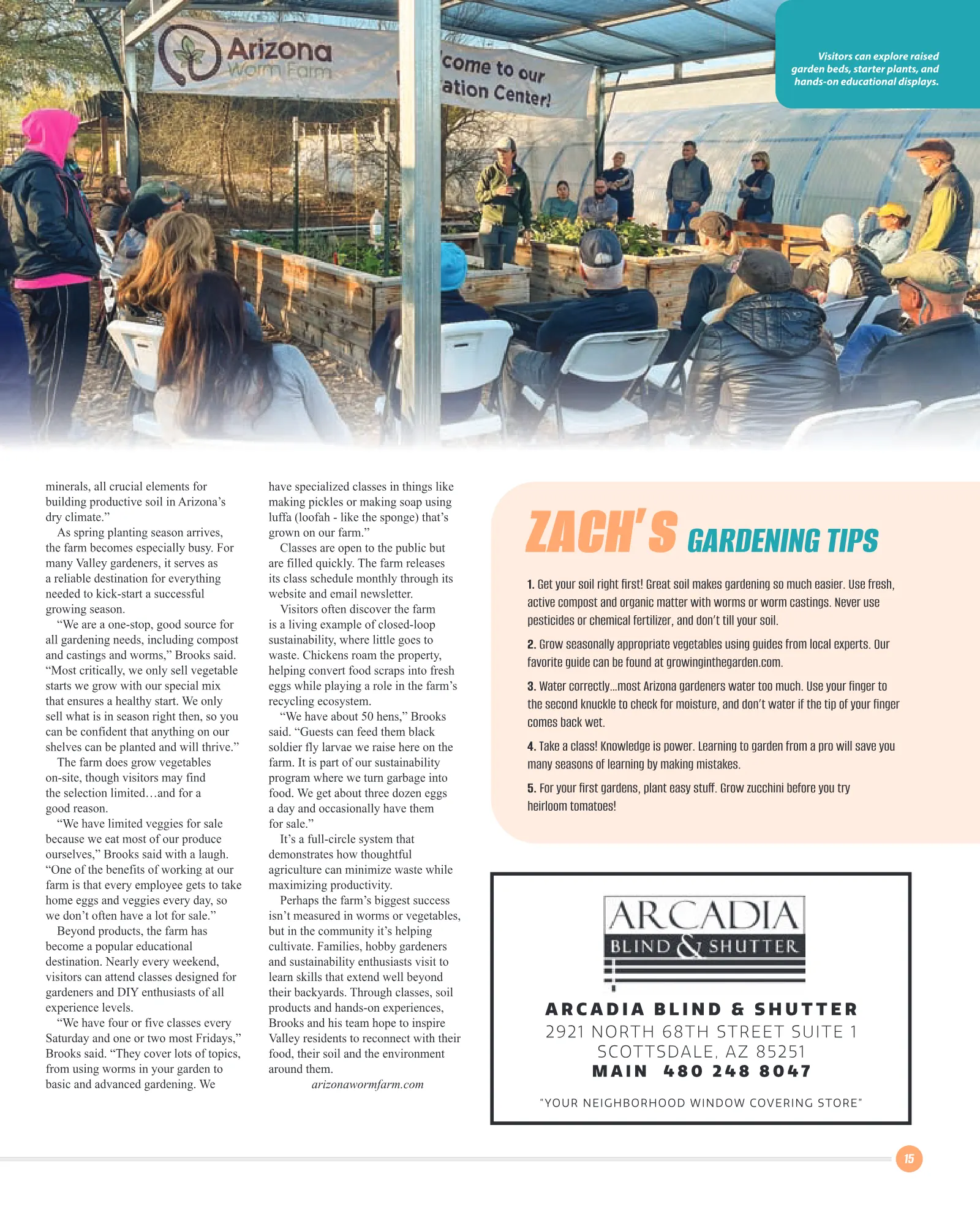
minerals, all crucial elements for building productive soil in Arizona’s dry climate.” As spring planting season arrives, the farm becomes especially busy. For many Valley gardeners, it serves as a reliable destination for everything needed to kick-start a successful growing season. “We are a one-stop, good source for all gardening needs, including compost and castings and worms,” Brooks said. “Most critically, we only sell vegetable starts we grow with our special mix that ensures a healthy start. We only sell what is in season right then, so you can be confident that anything on our shelves can be planted and will thrive.” The farm does grow vegetables on-site, though visitors may find the selection limited…and for a good reason. “We have limited veggies for sale because we eat most of our produce ourselves,” Brooks said with a laugh. “One of the benefits of working at our farm is that every employee gets to take home eggs and veggies every day, so we don’t often have a lot for sale.” Beyond products, the farm has become a popular educational destination. Nearly every weekend, visitors can attend classes designed for gardeners and DIY enthusiasts of all experience levels. “We have four or five classes every Saturday and one or two most Fridays,” Brooks said. “They cover lots of topics, from using worms in your garden to basic and advanced gardening. We have specialized classes in things like making pickles or making soap using luffa (loofah - like the sponge) that’s grown on our farm.” Classes are open to the public but are filled quickly. The farm releases its class schedule monthly through its website and email newsletter. Visitors often discover the farm is a living example of closed-loop sustainability, where little goes to waste. Chickens roam the property, helping convert food scraps into fresh eggs while playing a role in the farm’s recycling ecosystem. “We have about 50 hens,” Brooks said. “Guests can feed them black soldier fly larvae we raise here on the farm. It is part of our sustainability program where we turn garbage into food. We get about three dozen eggs a day and occasionally have them for sale.” It’s a full-circle system that demonstrates how thoughtful agriculture can minimize waste while maximizing productivity. Perhaps the farm’s biggest success isn’t measured in worms or vegetables, but in the community it’s helping cultivate. Families, hobby gardeners and sustainability enthusiasts visit to learn skills that extend well beyond their backyards. Through classes, soil products and hands-on experiences, Brooks and his team hope to inspire Valley residents to reconnect with their food, their soil and the environment around them. arizonawormfarm.com 15 Visitors can explore raised garden beds, starter plants, and hands-on educational displays. A R C A D I A B L I N D & S H U T T E R 2921 NORTH 68TH STREET SUITE 1 SCOTTSDALE, AZ 85251 M A I N 4 8 0 2 4 8 8 0 4 7 “YOUR NEIGHBORHOOD WINDOW COVERING STORE” ZACH’S GARDENING TIPS 1. Get your soil right first! Great soil makes gardening so much easier. Use fresh, active compost and organic matter with worms or worm castings. Never use pesticides or chemical fertilizer, and don’t till your soil. 2. Grow seasonally appropriate vegetables using guides from local experts. Our favorite guide can be found at growinginthegarden.com. 3. Water correctly…most Arizona gardeners water too much. Use your finger to the second knuckle to check for moisture, and don’t water if the tip of your finger comes back wet. 4. Take a class! Knowledge is power. Learning to garden from a pro will save you many seasons of learning by making mistakes. 5. For your first gardens, plant easy stuff. Grow zucchini before you try heirloom tomatoes!