
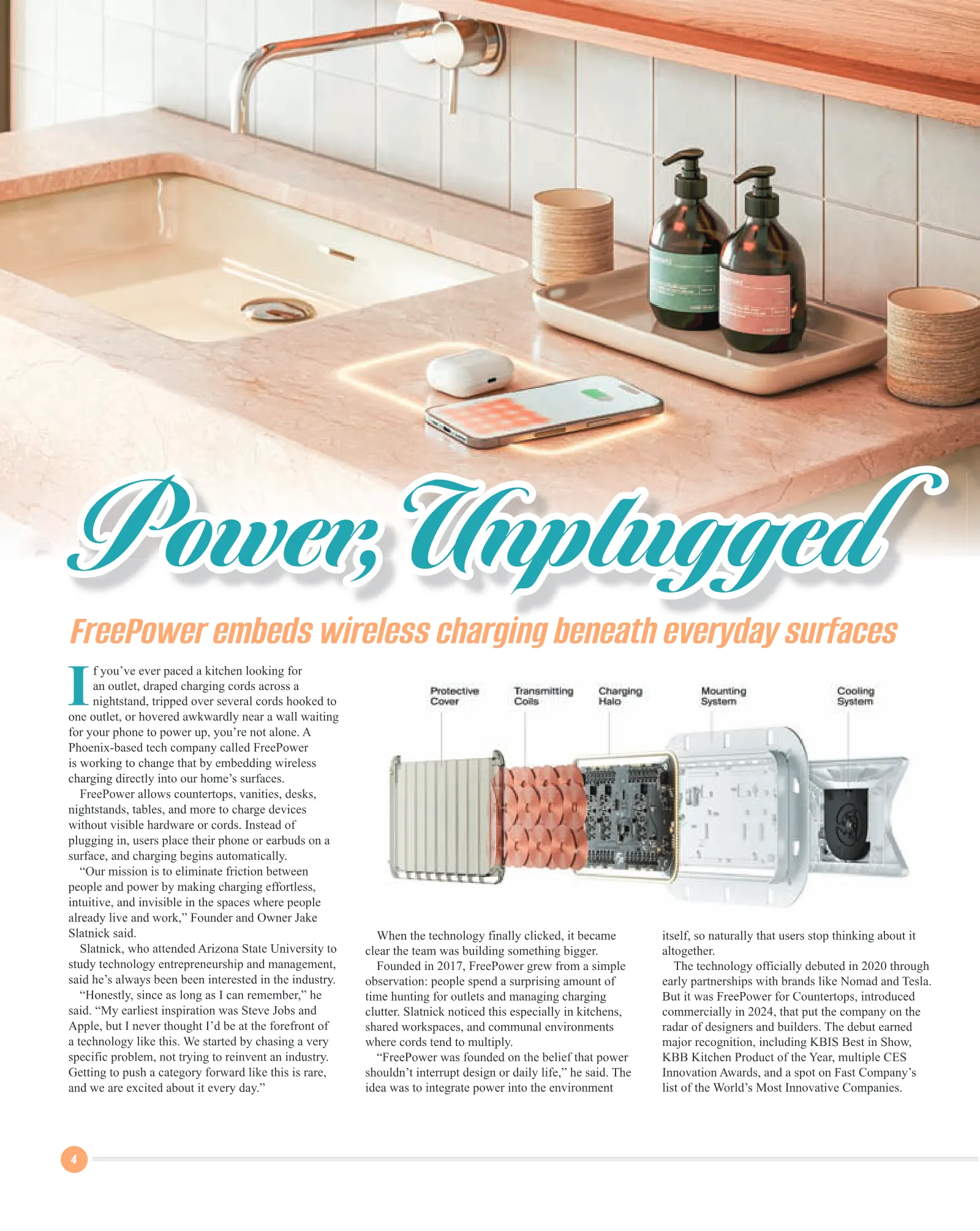
Power, Unplugg I f you’ve ever paced a kitchen looking for an outlet, draped charging cords across a nightstand, tripped over several cords hooked to one outlet, or hovered awkwardly near a wall waiting for your phone to power up, you’re not alone. A Phoenix-based tech company called FreePower is working to change that by embedding wireless charging directly into our home’s surfaces. FreePower allows countertops, vanities, desks, nightstands, tables, and more to charge devices without visible hardware or cords. Instead of plugging in, users place their phone or earbuds on a surface, and charging begins automatically. “Our mission is to eliminate friction between people and power by making charging effortless, intuitive, and invisible in the spaces where people already live and work,” Founder and Owner Jake Slatnick said. Slatnick, who attended Arizona State University to study technology entrepreneurship and management, said he’s always been been interested in the industry. “Honestly, since as long as I can remember,” he said. “My earliest inspiration was Steve Jobs and Apple, but I never thought I’d be at the forefront of a technology like this. We started by chasing a very specific problem, not trying to reinvent an industry. Getting to push a category forward like this is rare, and we are excited about it every day.” When the technology finally clicked, it became clear the team was building something bigger. Founded in 2017, FreePower grew from a simple observation: people spend a surprising amount of time hunting for outlets and managing charging clutter. Slatnick noticed this especially in kitchens, shared workspaces, and communal environments where cords tend to multiply. “FreePower was founded on the belief that power shouldn’t interrupt design or daily life,” he said. The idea was to integrate power into the environment itself, so naturally that users stop thinking about it altogether. The technology officially debuted in 2020 through early partnerships with brands like Nomad and Tesla. But it was FreePower for Countertops, introduced commercially in 2024, that put the company on the radar of designers and builders. The debut earned major recognition, including KBIS Best in Show, KBB Kitchen Product of the Year, multiple CES Innovation Awards, and a spot on Fast Company’s list of the World’s Most Innovative Companies. FreePower embeds wireless charging beneath everyday surfaces 4
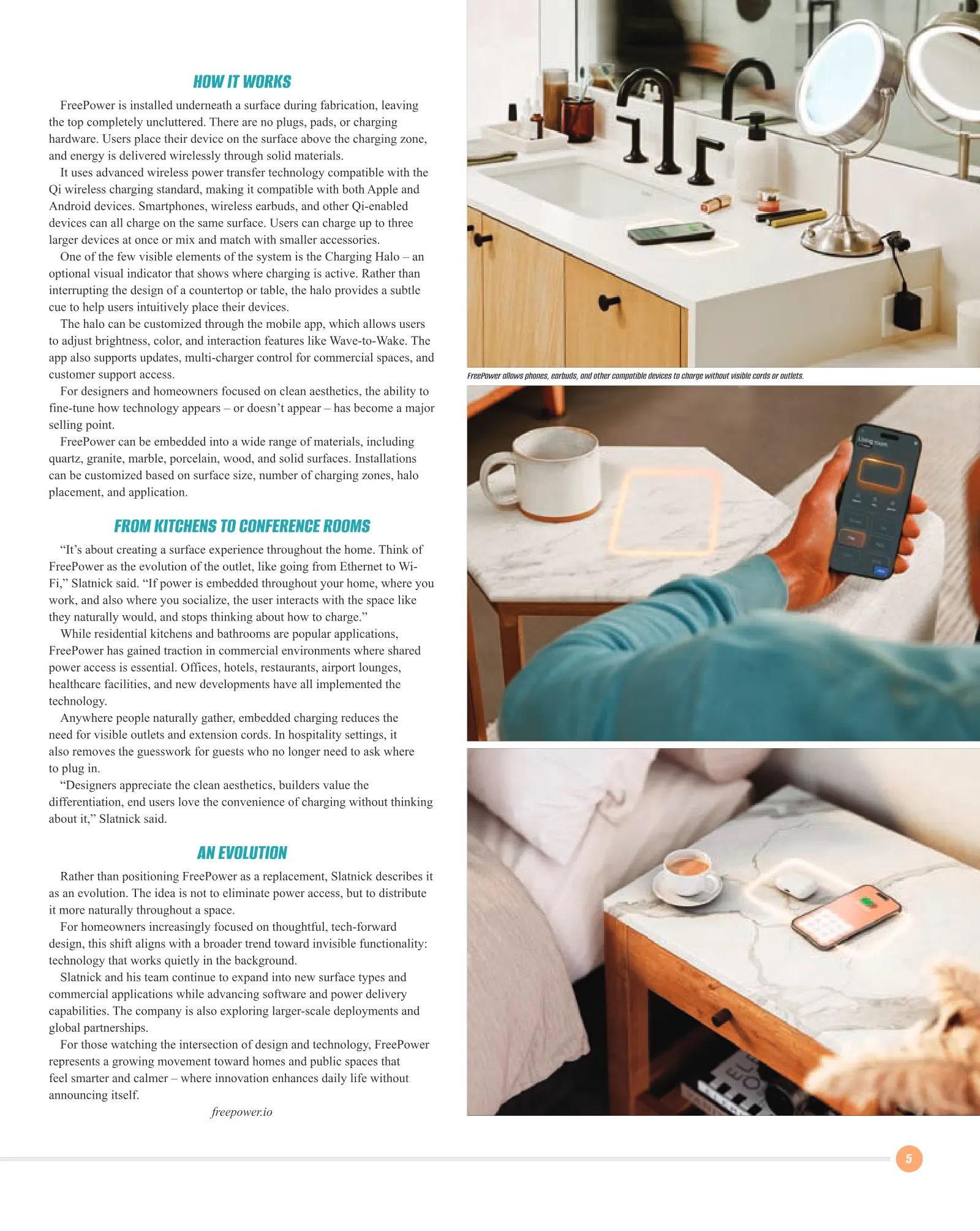
5 HOW IT WORKS FreePower is installed underneath a surface during fabrication, leaving the top completely uncluttered. There are no plugs, pads, or charging hardware. Users place their device on the surface above the charging zone, and energy is delivered wirelessly through solid materials. It uses advanced wireless power transfer technology compatible with the Qi wireless charging standard, making it compatible with both Apple and Android devices. Smartphones, wireless earbuds, and other Qi-enabled devices can all charge on the same surface. Users can charge up to three larger devices at once or mix and match with smaller accessories. One of the few visible elements of the system is the Charging Halo – an optional visual indicator that shows where charging is active. Rather than interrupting the design of a countertop or table, the halo provides a subtle cue to help users intuitively place their devices. The halo can be customized through the mobile app, which allows users to adjust brightness, color, and interaction features like Wave-to-Wake. The app also supports updates, multi-charger control for commercial spaces, and customer support access. For designers and homeowners focused on clean aesthetics, the ability to fine-tune how technology appears – or doesn’t appear – has become a major selling point. FreePower can be embedded into a wide range of materials, including quartz, granite, marble, porcelain, wood, and solid surfaces. Installations can be customized based on surface size, number of charging zones, halo placement, and application. FROM KITCHENS TO CONFERENCE ROOMS “It’s about creating a surface experience throughout the home. Think of FreePower as the evolution of the outlet, like going from Ethernet to Wi- Fi,” Slatnick said. “If power is embedded throughout your home, where you work, and also where you socialize, the user interacts with the space like they naturally would, and stops thinking about how to charge.” While residential kitchens and bathrooms are popular applications, FreePower has gained traction in commercial environments where shared power access is essential. Offices, hotels, restaurants, airport lounges, healthcare facilities, and new developments have all implemented the technology. Anywhere people naturally gather, embedded charging reduces the need for visible outlets and extension cords. In hospitality settings, it also removes the guesswork for guests who no longer need to ask where to plug in. “Designers appreciate the clean aesthetics, builders value the differentiation, end users love the convenience of charging without thinking about it,” Slatnick said. AN EVOLUTION Rather than positioning FreePower as a replacement, Slatnick describes it as an evolution. The idea is not to eliminate power access, but to distribute it more naturally throughout a space. For homeowners increasingly focused on thoughtful, tech-forward design, this shift aligns with a broader trend toward invisible functionality: technology that works quietly in the background. Slatnick and his team continue to expand into new surface types and commercial applications while advancing software and power delivery capabilities. The company is also exploring larger-scale deployments and global partnerships. For those watching the intersection of design and technology, FreePower represents a growing movement toward homes and public spaces that feel smarter and calmer – where innovation enhances daily life without announcing itself. freepower.io FreePower allows phones, earbuds, and other compatible devices to charge without visible cords or outlets.